
Tourism is on the rise in India. As per a report by the Ministry of Tourism, in the year 2022 the number of domestic tourist visits increased by 155 percent compared to previous year. This presents a great opportunity to create an application that can solve issues related to tourists, that will make it easy to find affordable accommodation online. My intention is to understand the issues they’ve been facing with the existing processes and thus come up with a solution for a new app called AIHA: An Indian Homestay App.
Survey among potential customers
To identify potential customers from India, who want to travel in the country, I created a survey form and shared in my network. Also, I interviewed a few people on the phone. The intent was to understand their behavior, need, and try to identify any unmet needs.
Based on my user research, I observed the following issues being faced by people when booking accommodation online:
- Hotels are too expensive.
- Listings aren’t always what they see online.
- Reviews can be fraudulent as google doesn’t have quality checks.
- Users book through different online systems, so no rewarding mechanism to use one single service.
- Sometimes people book a place online and when they physically reach there, the owner says that it is not available (due to lack of online integration).
- Visitors don’t get unique experiences like staying near a waterfall or an ancient temple.
- Too many listings makes it difficult to choose, and also the pricing can be confusing at times.
- People want to get a feel of the place online before booking, so that they get what they saw.
Despite solutions like Airbnb and Oyo, there is still a significant audience who hasn’t used them. Especially in Tier-II and Tier-III cities. Hence, there is scope for an alternative product in the market.
User Discovery
User persona
Based on survey, I broadly identified 3 personas:
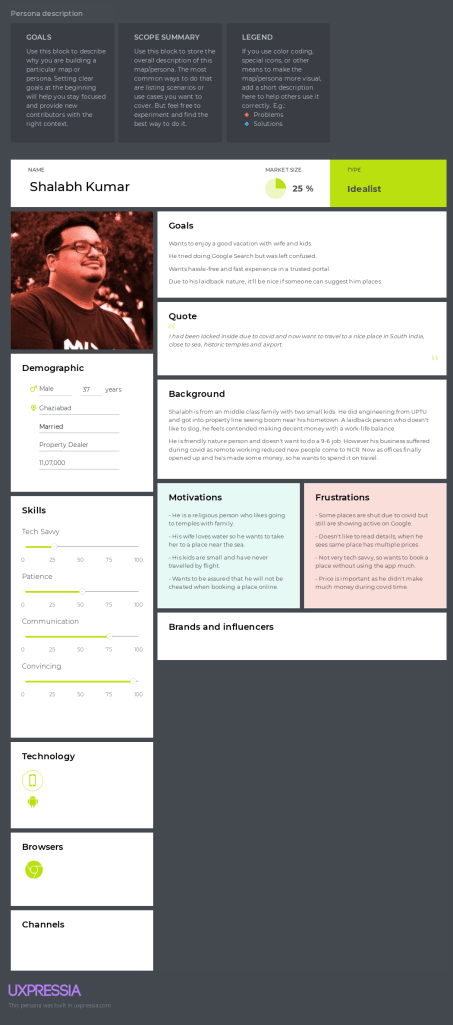
- Married man with wife and two kids, wants a short vacation at a good location in TN.
- A recently married woman, who wants to go on honeymoon.
- An elderly person from Gujarat who wants to travel in a group, to see religious places in North India.
The user persona for first one is below:
Empathy maps
| 1. What does he/she see? | 2. What does he/she think and feel? | 5. Gains |
| – Lots of hotels on the internet but I don’t know which one is right. – Confusing pricing, I don’t know what is right. – Lack of trust due to mixed reviews. | – The user thinks AIHA has good options at affordable prices. – User feels reluctant trying a new platform, what if it is too good to be true? | – Easy to use. – Value for money. – Lots of good options. – Save time by booking authentic places quickly. – Reward points. |
| 3. What does he/she hear? | 4. What does he/she say and do? | 6. Pains |
| – Experience might be inferior to a hotel. – Could be risky to try something new. | – Say: Stressed by finding the right place at AIHA. – Do: Ask their friends for experiences but they haven’t tried it yet. | – Concerns for security. – Feels branded hotels offer more professional stay. |
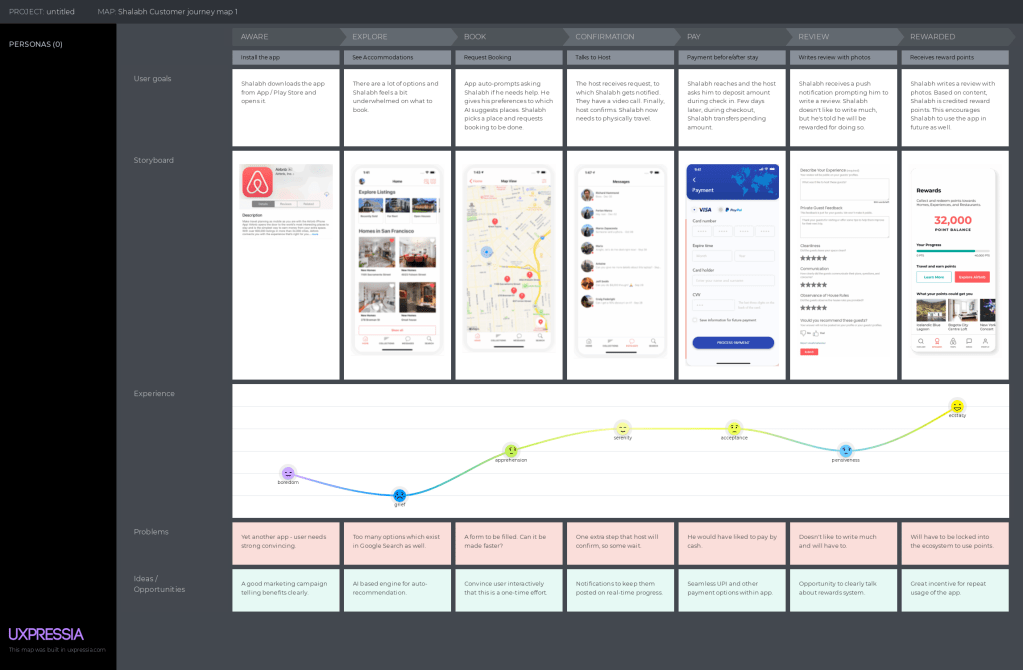
Users will learn about the app via social media campaigns that will emphasize on spending a good time in the mountains, as well as religious tourism that they can undergo. I made a journey of the main tasks that a user will undergo, from downloading the app to making a booking to getting rewarded.
Jobs to be done
Today, these are the top jobs that a user does to find and book an accommodation online (with hypothesis they’re not aware of Airbnb).
- A user searches for hotels on Google, based on the location they want to stay at. At times they ask their friends for recommendations, however that depends on if they’ve ever been to that place before.
- In case a property appeals to a user, then they look at it on different websites for these parameters – photos, reviews, prices, travel vlogs, etc.
- Once a user has made mind on selecting a property, then they call or email the hotel to make a booking. Mostly, people in India call the hotel. In some cases, a user constantly follows up just to be sure that their booking is confirmed.
- After reaching the hotel, a user does the payment, when they’re sure that the place resembles what they saw on Internet and that the rooms are available.
- Post completion of the stay, the user checks out of the hotel. The staff receptionist sometimes ask them to leave a review on a website, which is not the same for all, as it could be Google Maps, TripAdvisor, etc.
Importance vs Satisfaction
Following is the importance of different features to our target customers:
Must Have
- Actual places with confirmed bookings – These are all going to be operational places, so users will have trust.
- Users can choose locations as per proximity to railway station / bus stand / airport etc.
- Affordable prices lower than conventional hotels.
Performance Benefits
- Variety of stay options with filters to choose such as breakfast, airport cab, etc.
- Genuine photos and reviews from actual guests
- Transparent pricing as per facilities offered, so users will know what they’re getting and how much they have to pay.
Delighter Benefits
- Reward points for frequent bookings, which will include discounts and cashbacks.
- The app will offer places having unique experiences not offered by traditional hotels.
- To make it easier in choosing a place, we can have an AI engine to suggest places as per personal preferences of the customer.
Strategy Grid
| Airbnb | Google Search | AIHA | |
| Must Haves | |||
| Actual Places with Confirmed Booking | Yes | No | Yes |
| Affordable Price | Yes | Yes | Yes |
| Good Location | Low-Med | Medium-High | High |
| Performance Benefits | |||
| Variety of stay options with filters | Medium | Medium | High |
| Actual Reviews | Medium | Low | High |
| Transparent Pricing with facilities | High | Low | High |
| Delighter Benefits | |||
| Reward Points | Yes | No | Yes |
| Unique Experiences | Yes | No | Yes |
| AI recommends as per préférences | No | No | Yes |
Unmet needs
- Hassle-free payment , pre and post booking. Even though digital transactions have increased, people are still apprehensive of paying in full for something before having it. Therefore, users should get an option to request for booking, which the host can confirm after video calling the user. If the host wants then they can ask for escrow to prevent a no-show. Once a user reaches the place, they can pay the amount during check-in or after check-out, which will get reflected in their AirBnB’s profile.
- Reviews with user-uploaded photos, so that people know they aren’t reading fake opinions of those who never stayed there. This we intend to solve by showing a “verified stay” next to the reviewer’s name with dates they stayed at. Immediately after a hotel checks out a guest, they’ll receive email and push notification to write a review. Users who write a detailed review, shall be given reward points.
- To improve trust, we propose to provide a 360 degree VR view of the property before booking it. The intention is users will be able to see where they’re going to stay. We will encourage hosts to get the view remade every year, to be sure that what users are seeing is up-to-date.
Conclusion
By following the above journey, AIHA can solve the most pressing needs of Indian travelers looking to book genuine, affordable accommodation online.
 Yaju Arya Dot Com